First, the surprise
Okinawa soba contains no buckwheat at all. The noodles are 100% wheat — thick, wavy, satisfying — served in a broth built on pork bones and katsuobushi, Japan's smoked bonito. It sits somewhere between ramen and udon, and tastes like neither.
沖縄そば — Okinawa soba · in the local language, simply すば “suba”
Anatomy of the bowl
- 1Stewed pork ソーキ/三枚肉
The crown. Soki (spare ribs simmered until the bone slips out) or sanmainiku (three-layer pork belly glazed in soy and a touch of sugar).
- 2Wheat noodles 木灰そば
Thick and gently wavy. The oldest shops still make them the traditional way — with lye water drawn from wood ash — for a springy bite and faint minerality.
- 3Kamaboko かまぼこ
A slice of fish cake, often with a pink rim. Okinawan kamaboko has its own island tradition.
- 4Beni shoga 紅生姜
Red pickled ginger. A small heap cuts the richness of the pork.
- 5The broth だし
Pork bones simmered clear, rounded out with katsuobushi. Lighter than tonkotsu, deeper than it looks. Many shops guard the ratio like a family secret.
Okinawa soba vs. ramen vs. soba
| Okinawa Soba | Ramen | Japanese Soba | |
|---|---|---|---|
| Noodle | 100% wheat with alkaline water — traditionally wood-ash lye — thick & wavy | Wheat with kansui, thin–medium | Buckwheat (at least in part) |
| Broth | Pork bones + katsuobushi, clear & gentle | Chicken/pork/seafood, assertive | Dashi + soy (tsuyu), light |
| Topping | Soki ribs or pork belly, kamaboko | Chashu, egg, nori | Scallion, wasabi, tempura |
| Table hot sauce | Koregusu (chili in awamori) | Chili oil, pepper | Shichimi |
| When locals eat it | Lunch, daily | Late night | Special occasions, New Year |
Know your bowls
6 you'll actually meetOkinawa Soba
The classic. Sanmainiku pork belly, kamaboko, scallions. If the menu says only “soba”, this is what arrives.
Soki Soba
Topped with soki — pork spare ribs stewed soft in soy and awamori. The most famous version outside Okinawa.
Tebichi Soba
For the brave and the devoted: pig's trotters simmered to a collagen-rich, chopstick-tender wobble.
Yaeyama Soba
Thin, round, straight noodles; a slightly sweet broth; pork cut in fine strips. Native to Ishigaki and the far southern islands.
Miyako Soba
Flat noodles — and by tradition the toppings hide under them, a habit said to date from frugal times.
Yushi-dofu Soba
Crowned with a cloud of warm, barely-set island tofu. The gentlest bowl on the menu, beloved for breakfast.
Field notes — eat it like a local
Go at lunch. Really.
Most shops simmer one batch of broth each morning and close when it's gone — often by 2 pm. “Sold out” at 1 pm is a badge of honor.
Find the koregusu
The small bottle on every table holds island chilies steeped in awamori rice spirit. A few drops wake the broth up. It's hotter than it looks — start small.
Rice on the side
Locals pair the bowl with jushi — Okinawan seasoned rice — or a couple of onigiri. No one will judge the carb-on-carb; it's tradition.
The name was worth a fight
In the 1970s regulators argued wheat noodles couldn't legally be called “soba.” The island pushed back, and on October 17, 1978 the name 本場沖縄そば (Honba Okinawa Soba) won official approval as a designated product name under Japan's fair-competition rules. That date is now Okinawa Soba Day.
Wood-ash noodles are the old soul
Before industrial lye water, noodle makers filtered water through hardwood ash. A handful of shops keep the 木灰 (mokuhai) method alive — seek them out.
Every region argues about theirs
Naha, Nago, Ishigaki, Miyako — noodle shape, broth sweetness, even where the toppings go. Asking a local “whose soba is best?” is the fastest way to start a friendly argument.
Questions people actually ask
問Is Okinawa soba made from buckwheat?
問So is it just ramen, then?
問What should I order first?
問What is koregusu?
問Why was the shop closed at 2 pm?
問When is Okinawa Soba Day?
Go deeper
from the field guideOkinawa Soba, at Home
Clear pork-and-bonito broth, glazed pork belly, and honest advice on noodles outside Japan.
Read → ComparisonOkinawa Soba vs. Ramen
Same noodle family, different upbringing. A point-by-point deep dive.
Read → HistoryThe Day the Name Was Saved
From royal-era banquets to postwar flour rations and the 1978 fight over the word “soba.”
Read → Regional GuideOkinawa, Miyako, Yaeyama
Round noodles, hidden toppings, pipatsu pepper — how the bowl changes island by island.
Read → CondimentWhat is Koregusu?
The awamori-chili bottle on every table — its history, naming mystery, and a make-your-own recipe.
Read → CultureOkinawa Soba Day (Oct 17)
The only food holiday born from a legal victory. The story, and how to join in from anywhere.
Read → Side DishWhat is Jushi?
The seasoned rice locals order beside every bowl — with ceremonial roots and a home version.
Read → CraftWood-Ash Soba
Fire, water, patience: the pre-industrial noodle method a devoted few never abandoned.
Read → Menu DecoderSoki, Tebichi & Friends
Hon-soki vs soft-bone, melting trotters, the ordering cheat sheet.
Read → Shop GuideSoba Near Naha Airport
Three bowls worth your layover — with live hours via Google Maps.
Read →A hands-on Okinawa noodle experience for families is in the works.
We're planning a way for visiting families to get their hands floury with the island's noodle culture. Details are still taking shape — join the early-access list and you'll be the first to know when it's ready.
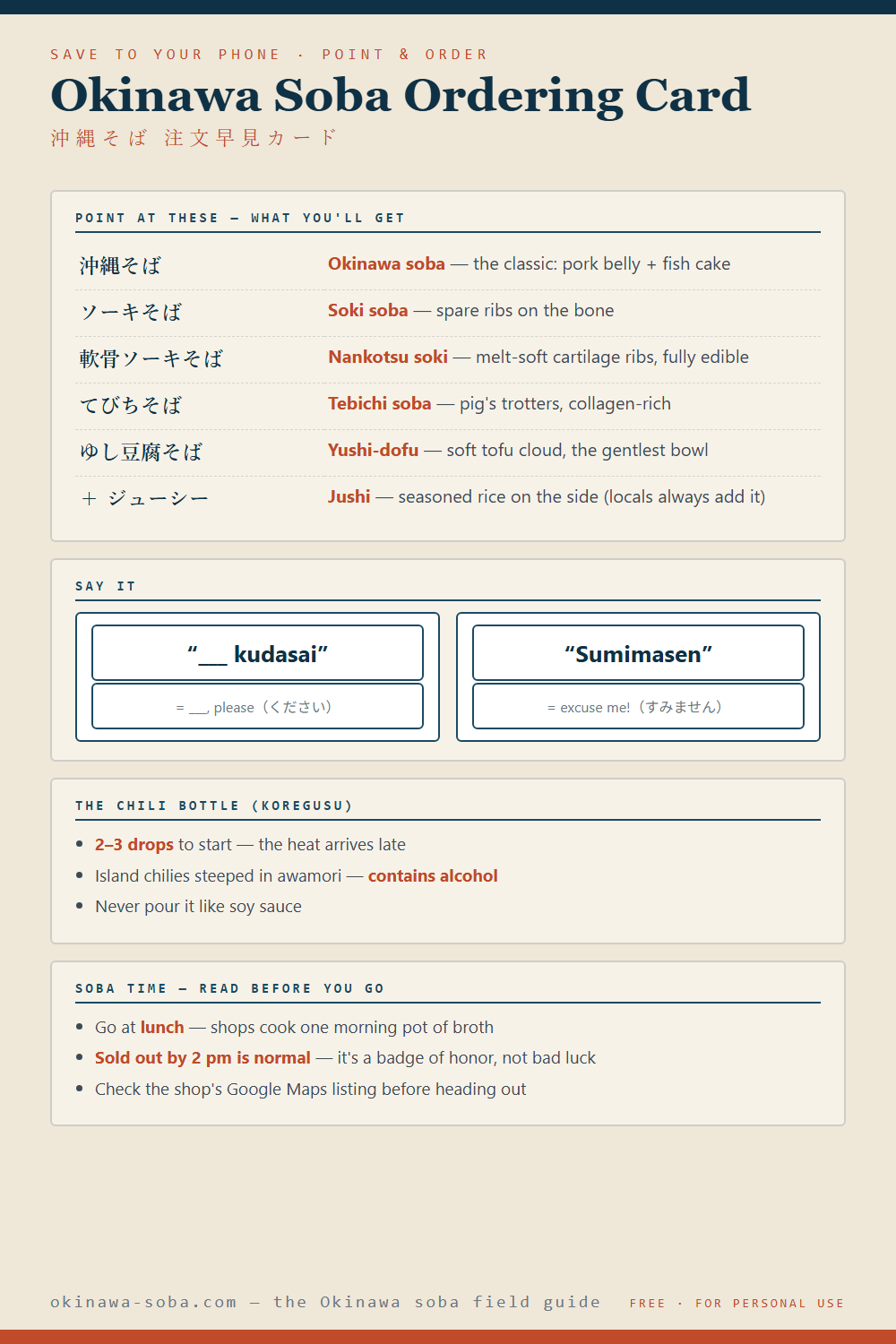
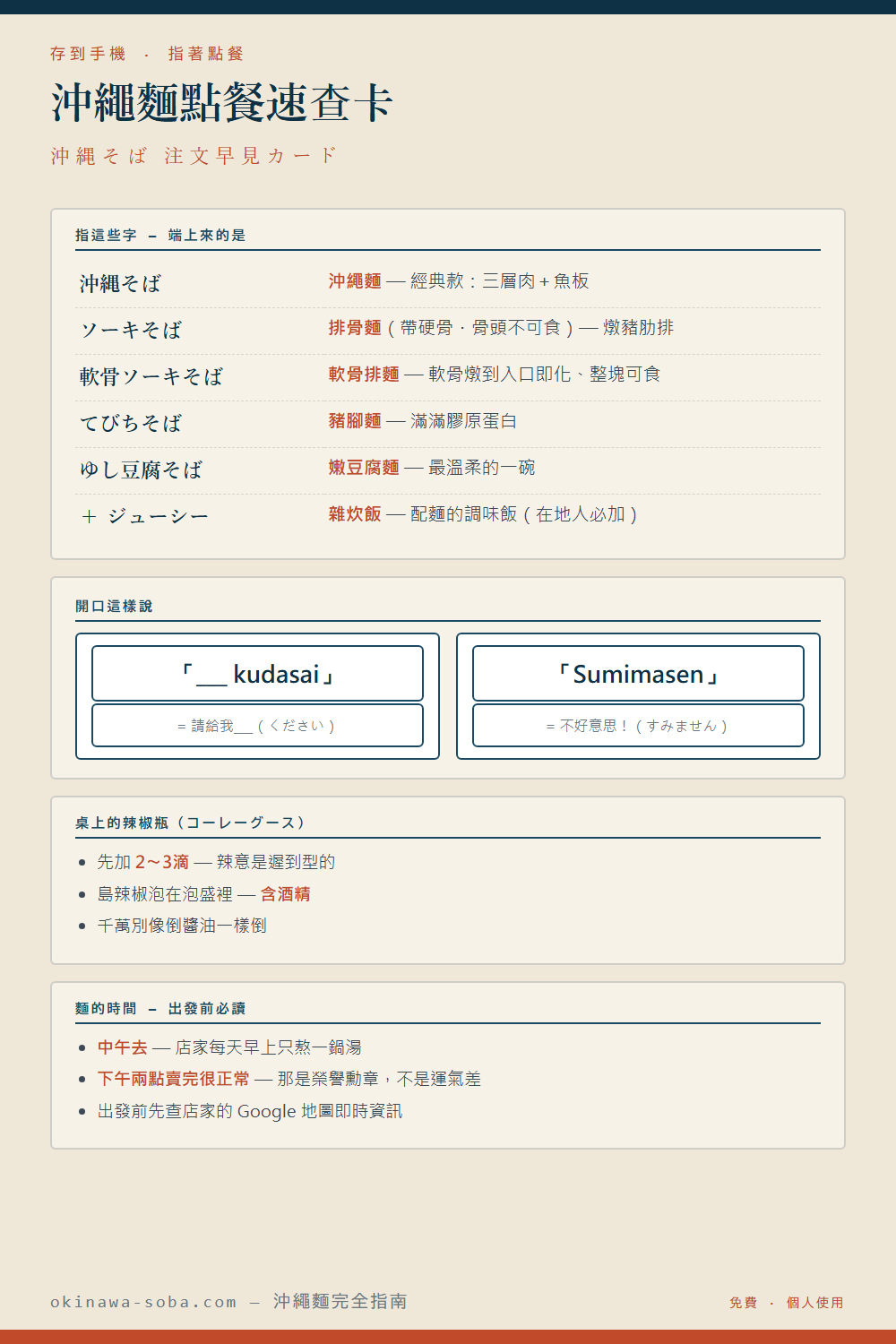
Instant bonus: sign up and get our Okinawa Soba Ordering Card — a free save-to-your-phone cheat sheet for pointing, ordering, and eating like a local (English & 繁體中文).
Your bonus is ready: Download the Ordering Card (English) · 繁體中文版
Written and photographed in Okinawa. Your address is stored on this server only and never shared.